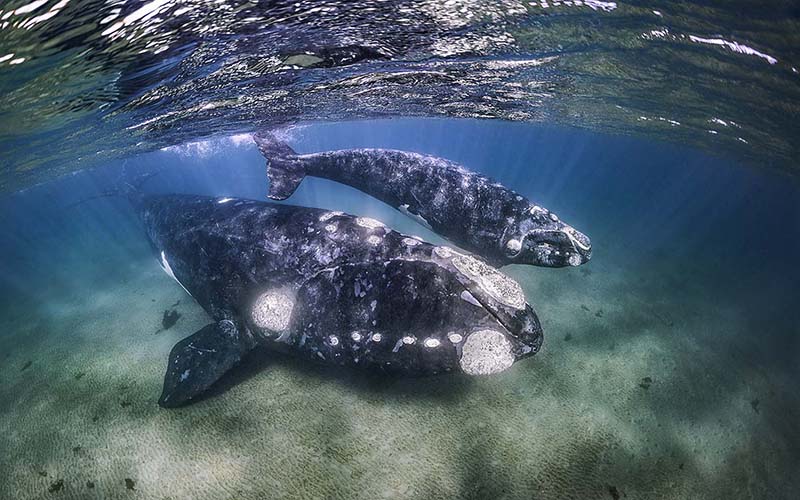
journalofserviceclimatology.org – The Southern right whale, a majestic and large baleen whale, is one of the most iconic species in the Southern Ocean. Once heavily hunted to the brink of extinction, this species has experienced a remarkable recovery in recent decades, thanks to dedicated conservation efforts. Today, the Southern right whale is a symbol of the resilience of nature and the success of global conservation efforts.
Physical Characteristics
The Southern right whale is a massive creature, reaching lengths of up to 60 feet (18 meters) and weighing as much as 80 tons. This whale has a robust, stocky body with a broad, flat head that makes up about one-third of its total length. One of the most distinctive features of the Southern right whale is its lack of dorsal fin and the presence of callosities (rough patches of skin) on the top of its head, around the blowholes, and along its jawline. These callosities are home to small organisms like lice and barnacles and are unique to each individual, allowing scientists to identify them.
The Southern right whale’s body is typically black or dark gray, although some individuals may have white patches on their bellies or lower jaws. Their baleen plates are long and black, used to filter out tiny organisms such as krill and plankton from the water.
Habitat and Distribution
The Southern right whale is primarily found in the Southern Hemisphere, with populations spread across the coasts of South America, South Africa, Australia, and New Zealand. These whales are migratory, spending the summer months in the cold, nutrient-rich waters of the Southern Ocean to feed and the winter months in warmer waters to breed and calve.
One of the most notable features of the Southern right whale is its preference for coastal waters, often found close to shore. This behavior, while making them more vulnerable to human activity, also makes them one of the most visible whale species, and they can often be seen from shore during their seasonal migrations.
Diet and Feeding Habits
Southern right whales are filter feeders, using their baleen plates to strain out tiny marine organisms from the water. Their primary diet consists of copepods, krill, and other planktonic creatures that are abundant in colder waters. These whales feed by swimming with their mouths open and using their large tongues to expel water and trap food in their baleen plates.
In the summer months, when food is abundant, Southern right whales focus on building up fat reserves to sustain them during the winter breeding season. Their feeding grounds are typically found in colder waters, off the coasts of places like Argentina, South Africa, and Australia.
Behavior and Communication
Southern right whales are known for their slow-moving and gentle nature. They are often seen near the surface of the water, where they engage in behaviors like breaching, tail-slapping, and spy-hopping (lifting their heads above the surface). These behaviors are thought to serve a variety of purposes, including communication, social interaction, and possibly removing parasites from their skin.
The Southern right whale’s vocalizations are important for communication, and they produce a variety of low-frequency sounds, including moans, grunts, and pulses. These sounds are believed to help with navigation, social bonding, and mate attraction. Their vocalizations can be heard over long distances, often traveling through the water to reach other whales.
Southern right whales are also known for their strong maternal bonds. Calves are typically born in the winter months and are nursed for several months before they are weaned. The mothers are fiercely protective of their young, and the relationship between them is crucial for the calf’s survival.
Conservation Status
The Southern right whale’s population suffered dramatic declines during the 19th and early 20th centuries due to commercial whaling. At one point, the species was reduced to only a few hundred individuals. However, thanks to international conservation efforts and the cessation of whaling in the 1930s, the Southern right whale population has been steadily recovering.
Today, the International Union for Conservation of Nature (IUCN) lists the Southern right whale as “Least Concern” due to the species’ significant recovery, with an estimated population of around 15,000 individuals. While the species has made a remarkable comeback, it still faces threats from ship strikes, entanglement in fishing gear, and habitat degradation caused by human activities.
Efforts to protect the Southern right whale include the establishment of marine protected areas, shipping lane restrictions to reduce collisions, and monitoring programs to track population health and movements. These efforts have played a critical role in the whale’s recovery and continue to be essential in ensuring its long-term survival.
Conclusion
The Southern right whale is a testament to the power of conservation and the resilience of nature. From the brink of extinction to a steady population recovery, this magnificent whale species has proven that with the right protection and conservation measures, even the most vulnerable animals can make a comeback. As their populations continue to grow, the Southern right whale remains a symbol of hope for marine conservation and the ongoing effort to protect the world’s oceans.